We earn a commission when you buy through our links, at no extra cost to you.
How does RC drifting work?
RC drift cars use hard plastic tires with very little grip, so the rear end slides when you turn and add throttle. You steer the slide with the steering and throttle.
Cheap drift cars are usually 4WD with slick tires, which makes sliding easy but less realistic. Serious drift cars are rear-wheel drive (RWD) with a steering gyro that automatically counter-steers, so you can hold long, smooth drifts like a real car.
Which RC drift car should I get?
Start with a mini or toy drift car for indoor fun. Move to a RWD gyro drift car if you want realistic, controlled drifting.
| Type |
Typical price |
Best surface |
Who it's for |
| Mini 1/24 to 1/76 drifters |
About $15 to $70 |
Kitchen floors, tables, small tracks |
Kids, desk fun, first try |
| Toy-grade 1/14 to 1/16 |
About $30 to $80 |
Garage, smooth pavement |
Older kids, casual drifting |
| Licensed movie cars |
About $40 to $100 |
Floors, smooth pavement |
Fans and gifts |
| Hobby RWD gyro drift cars |
About $200 and up, plus battery |
Polished concrete, P-tile, smooth asphalt |
Hobbyists who want real drifting |
What's the best surface for RC drifting?
Smooth, clean, hard floors: polished concrete, garage floors, tile and smooth asphalt. Rough or dusty ground makes drifting jerky.
Indoor floors work great for mini drifters. For bigger cars, an empty, smooth parking area or a garage gives you room for full slides. Set up a few cones to practice figure eights.
Do I need a gyro to drift?
Not for 4WD toy drifters. For rear-wheel-drive drift cars, yes: a gyro makes controlled drifting far easier.
A steering gyro senses the car's rotation and adds counter-steer automatically. Without one, a RWD car spins easily. Most serious RWD drift cars include a gyro or have a spot for one.
Mini drift cars: worth it?
Yes, for fun and for learning. Mini drift cars are cheap, run indoors and many come with spare tires and cones.
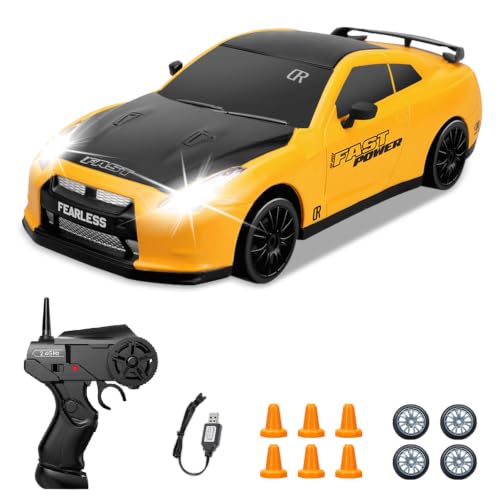
Mini 1/24 and 1/28 drifters are the most popular way to start. They're great gifts and need no special space. The 1/24 4WD RC Drift Car With LED Lights (the same car is also sold as Desdoni and YUAN PLAN) and the WLtoys 1/28 Mini Drift Car (284131) are two popular options at different levels.
How much does an RC drift car cost?
About $15 to $80 for mini and toy drifters, and $200 and up for hobby RWD drift cars before battery and charger.
Hobby drift cars often come without a battery and charger, so budget extra. Our RC car batteries page explains what to buy.
How do I get better at RC drifting?
Start slow, practice smooth throttle and small steering inputs, and set up cones for figure eights and simple corners.
Drifting is about balance. Too much throttle spins the car; too little and it straightens out. Practice holding a slide around a single cone, then link two cones in a figure eight. On RWD cars, adjust the gyro gain until the car holds slides without wobbling.
What tires do RC drift cars use?
Hard plastic or very hard compound tires. They slide instead of grip, which is what makes drifting possible.
Different drift tire compounds suit different surfaces. Many mini drifters come with both grip tires and drift tires, so you can switch between racing and sliding.
Are licensed movie drift cars any good?
They're fun, toy-grade drift cars with great looks, ideal as gifts for fans.
Licensed Fast & Furious cars from Jada Toys, like the Jada Fast & Furious Han's Mazda RX-7 Drift RC Car, are made for casual drifting on smooth floors. They're not hobby-grade, but they're a fun way to start.
Can I drift with a normal RC car?
An on-road RC car can drift if you fit hard drift tires. Off-road cars with knobby tires usually grip or flip instead.
Touring cars and some 1/10 on-road chassis convert well to drifting with drift tires and a few setup changes. That's a good path if you already own an on-road car. If you're starting fresh, a car built for drifting is easier because the tires, weight balance and gearing are already set up to slide smoothly. For realistic rear-wheel-drive drifting, look for a model that includes a steering gyro, or budget to add one. Mini drift cars remain the cheapest and quickest way to find out whether you enjoy drifting before spending more.
Brands to know
See every pick compared in our best RC drift cars guide. Prefer racing on pavement? Browse F1 RC cars and mini RC cars.
Popular picks
FAQ
What is the best RC drift car for a beginner?
A 1/24 mini drift car is the easiest start: cheap, runs indoors and usually comes with drift tires. If you already know you want realistic drifting, a rear-wheel-drive drift car with a gyro is the next step, though it costs more and needs a smooth surface.
Can any RC car drift?
Many on-road RC cars can drift with hard drift tires fitted. Off-road cars with knobby tires mostly grip or tumble instead. Purpose-built drift cars have the right tires, weight balance and often a gyro, so they slide far more smoothly.
What is a gyro in an RC drift car?
A gyro is a small sensor that detects the car rotating and automatically adds counter-steering. It keeps rear-wheel-drive drift cars from spinning out, so you can hold long, controlled slides. Most 4WD toy drifters don't need one.
Is RWD or 4WD better for RC drifting?
RWD is more realistic and is what most serious RC drifters use, but it needs a gyro and practice. 4WD drifting is easier and more forgiving, which is why most cheap drift cars are 4WD. Start with 4WD; move to RWD if you get hooked.
What surface do I need for an RC drift car?
A smooth, clean, hard surface: polished concrete, tile, garage floors or smooth asphalt. Carpet and rough ground stop the tires sliding evenly. Dust also makes slides unpredictable, so sweep the area before you drive.